Enterprise call recording
Active and passive recording support for enterprise telephony. The documented Cisco CUCM active-recording workflow uses SIP and Built-in Bridge, with near- and far-end call legs combined into a playable recording.
INDEPENDENT PRODUCT DEVELOPMENT / FLAGSHIP PROJECT
From spare-time idea
to everyday enterprise use.
I’m the sole creator and developer of UnifiedRecorder, an on-premises call recording and management platform for Cisco CUCM. I built the product independently in my spare time — from the Go backend and MySQL database to extensive Bash scripting, the dashboard, integration, and Ubuntu deployment.
Employees in the company using it
Calls recorded per day
Backend & database
Supported recording modes
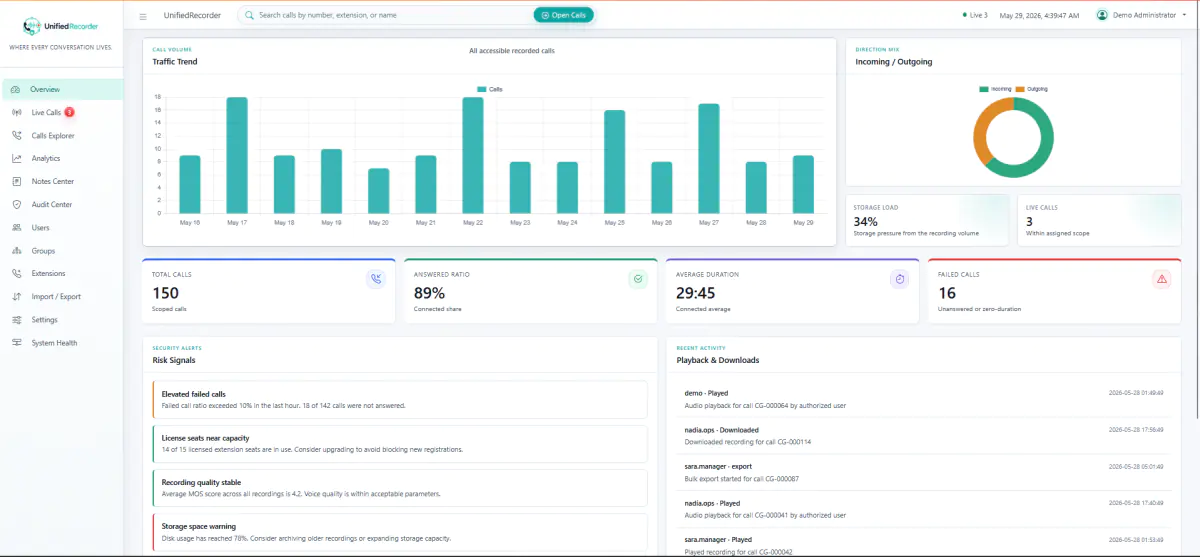
Actual dashboard interface, shown with demo data. The production figures above describe its use in a company with 500+ employees.
Explore the demo01 THE PRODUCT
A recording is only the beginning. A usable enterprise product also needs to make those recordings searchable, accessible to the right people, and manageable over time.
UnifiedRecorder brings those responsibilities together: recording capture, playback, live monitoring, analytics, access management, audit logging, and retention. It runs on Ubuntu inside the organization’s infrastructure.
My ownership spans the application and the delivery around it: the backend, database, web interface, Bash scripting, Cisco integration, installation workflow, and product documentation. Community and Pro editions provide separate entry points for evaluation and production use.
02 WHAT I BUILT
Recording workflows, a management application, and the operational tools around both — developed as one product.
Active and passive recording support for enterprise telephony. The documented Cisco CUCM active-recording workflow uses SIP and Built-in Bridge, with near- and far-end call legs combined into a playable recording.
Search, filters, waveform playback, downloads, tags, notes, and exports turn captured audio into a workable recording library. Users can narrow results by date, direction, site, department, and other call attributes.
A six-tier access model separates visibility from permitted actions. Extension groups define which calls people can see; access levels determine whether they can view metadata, play, download, export, or administer recordings.
Live-call views, volume trends, direction breakdowns, and extension analytics provide operational context. System health brings host information, CPU, memory, storage, and detected telephony-platform details into the application.
Recording access and administrative activity are logged, with filters for action, severity, user, and date. Plays, downloads, exports, authentication, and account changes can be reviewed from a dedicated audit workspace.
Managed jobs cover recording retention and silence processing, with scheduling and audit visibility. A guided Ubuntu installer handles the software dependencies and service setup needed to bring the application into operation.
03 THE TECHNICAL FOUNDATION
Built with the same concern for deployment, access, and day-to-day operation that I bring to enterprise infrastructure.
Backend development for the recording management platform.
The application’s database layer.
Used extensively throughout the project alongside the Go application.
On-premises deployment with a guided installation workflow.
Active & passive recording
Search, playback & organization
Scoped permissions & audit logs
Health, maintenance & retention
04 THE SKILLS BEHIND THE PRODUCT
The value is in bringing disciplines together and taking responsibility for the complete result.
05 THE OUTCOME
UnifiedRecorder is used in a company with more than 500 employees and records 300–400 calls per day. Building it in my spare time gave me ownership of the complete journey, from the first implementation to a product people use in everyday operations.
Visit UnifiedRecorder